· Eduardo Vieira · Modernization · 5 min read
Modern SCADA: Boundaries, Resilience, and Safe Migration
A practical architecture guide to HMI boundaries, event history, segmentation, recovery drills, and staged SCADA migration.
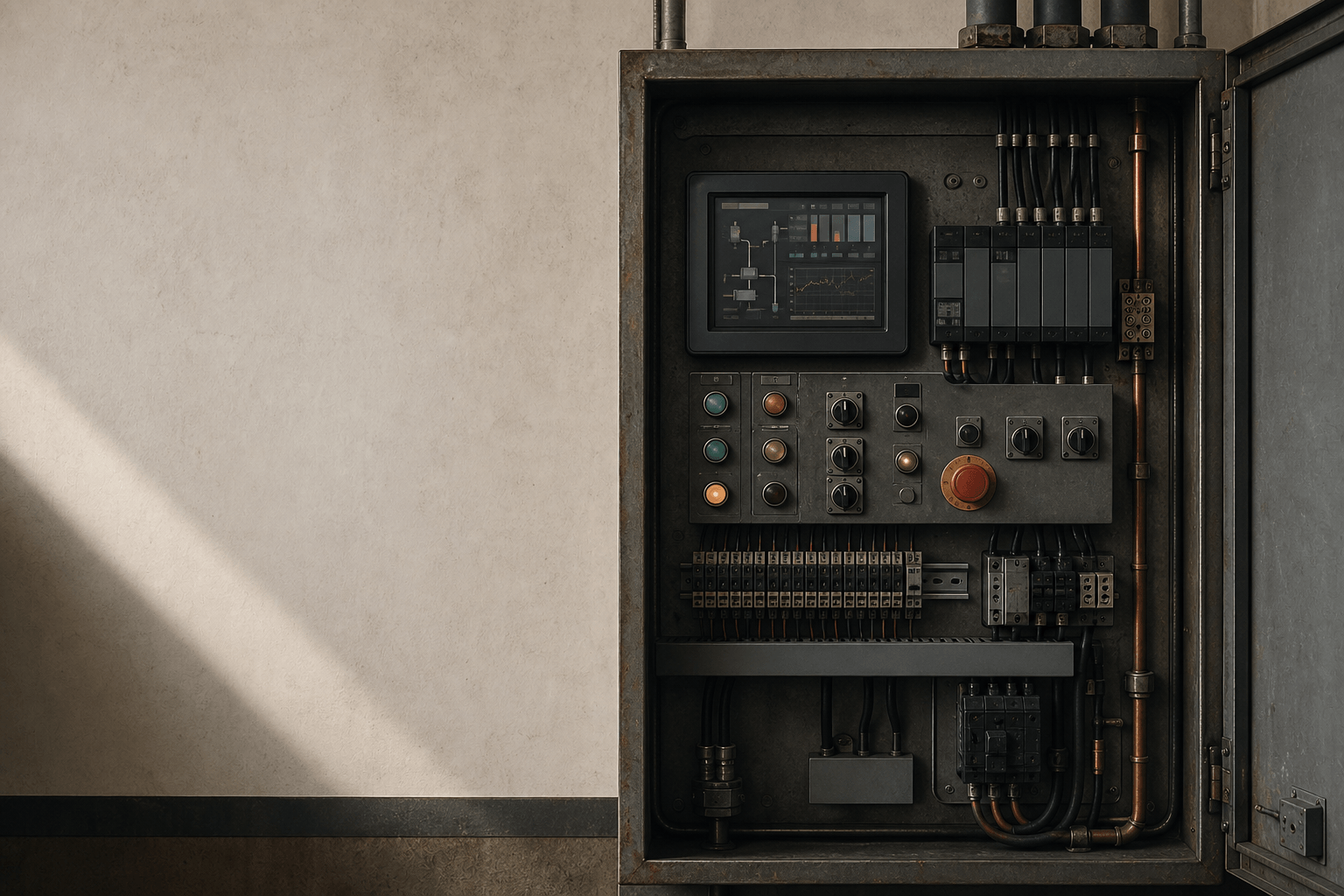
A modern SCADA program is not a browser makeover. It is a controlled redesign of how operators observe a process, issue supervisory commands, investigate abnormal conditions, and recover services. The architecture must respect the physical process, existing control authority, and site operating procedures. A polished screen cannot compensate for ambiguous ownership, weak network boundaries, or an untested restore path.
Draw the HMI/SCADA boundary first
The HMI presents process state and operator actions. SCADA typically adds supervisory acquisition, command handling, alarms, event collection, history, and communications across controllers or remote sites. Neither should silently replace PLC, RTU, SIS, or local equipment logic. Interlocks, permissives, safe states, and deterministic control remain in the layer designed and validated for them.
A web HMI is therefore a client, not a new safety layer. Keep it on controlled networks, authenticate users, authorize each action, and route commands through the established supervisory path. Do not expose it directly to the public Internet. Remote access, when justified by risk and operations, needs managed entry points, monitoring, limited duration, and an explicit way to revoke access.
Separate values, history, alarms, and events
These records answer different questions:
- Current values describe the latest known state, including quality and timestamp.
- Historian samples support trends and analysis; collection mode, deadband, retention, and aggregation affect interpretation.
- Alarms represent abnormal conditions that may require operator response. Their lifecycle includes activation, acknowledgement, return to normal, shelving rules, and priority.
- Events record discrete occurrences such as login, mode change, command, configuration change, or failover. An event is evidence, not necessarily an alarm.
OPC UA provides an integrated information and service model for data, Alarms and Conditions, and historical access. That architecture can improve semantic consistency, but using OPC UA does not prove that an application implements every profile or preserves every event during failure. Define stable source identifiers, quality, source and server timestamps, alarm state transitions, acknowledgement identity, and retention rules before migrating displays.
The ThingsBoard industrial monitoring guide applies the same values-and-history distinction to an integration layer.
Redundancy is a mechanism, not an uptime promise
Two servers do not automatically create an available service. Shared dependencies, licensing, storage, identity, network paths, and operator clients may remain single points of failure. Document what state is replicated, how split-brain is prevented, what triggers failover, and what clients must do afterward.
The OPC UA Alarms and Conditions model is explicit that cold or warm failover may require an event refresh; hot failover may also require one. Test retained conditions, acknowledgements, sequence continuity, historical gaps, and client reconnection. Report observed recovery time and data loss from a defined test. Do not turn those observations into universal uptime or latency guarantees.
Build zones and narrow conduits
NIST SP 800-82 Rev. 3 treats OT security in the context of performance, reliability, and safety constraints. Its defense-in-depth guidance includes segmentation or zoning by function or location. CISA likewise recommends layered ICS architecture, segmentation where possible, DMZs, controlled traffic between ICS and corporate networks, hardened remote access, and monitored connections.
Map required flows before opening ports. Place operator stations, SCADA services, historians, engineering workstations, remote-access infrastructure, and enterprise consumers in appropriate zones. Permit only documented source, destination, protocol, and direction. A reporting requirement does not justify a general route from enterprise clients to controllers.
Apply least privilege to people and services. Separate operator, engineer, administrator, service, and read-only reporting roles. Avoid shared accounts; record identity for commands and acknowledgements. Use separate OT credentials where the risk assessment requires it, protect privileged access, and remove dormant access. Security controls must not obstruct emergency procedures without an approved operational alternative.
The IT/OT convergence survival guide provides the ownership and conduit model for those zones.
Treat time and recovery as dependencies
Alarm analysis fails when controllers, servers, clients, and identity systems disagree about time. Define authoritative time sources, allowed drift, time zone and daylight-saving handling, source-versus-server timestamp semantics, and behavior when synchronization is lost. Monitor offset and preserve quality indicators rather than quietly presenting uncertain chronology.
Back up more than application projects. Include server configuration, alarm definitions, historian schemas, certificates and trust lists, identity dependencies, scripts, licenses where permitted, and controller interface mappings. Protect backups from the same administrative failure or ransomware path as production.
A backup is only a hypothesis until restored. Run scheduled restore drills in an isolated environment, verify integrity and version compatibility, reconnect only to simulated interfaces, and record recovery steps, duration, missing dependencies, and owners. Update the runbook from what the drill actually revealed.
Migrate in stages with a real rollback
Start with an inventory of assets, data flows, tags, alarms, interfaces, users, dependencies, and operational constraints. Capture an approved baseline and acceptance criteria. Then build the new stack offline, using recorded or generated data. Compare tag quality, units, timestamps, alarm transitions, history, audit records, and role behavior.
Pilot a bounded area in read-only shadow mode. Move write authority only after hazard review, operator training, access testing, backup validation, and an approved change window. Define rollback triggers before cutover: unacceptable data gaps, incorrect alarm behavior, command-path defects, time drift, or failed failover. Preserve the old configuration and a tested return procedure until the new service meets the agreed observation period.
For an approved staged migration, HMI and SCADA services can implement the reviewed scope.
The example below is deterministic documentation, not a connection recipe. It exercises one alarm transition and one audit event without plant connectivity:
{"sequence":1,"source":"SIM-TANK-01","kind":"alarm","state":"active","priority":2,"sourceTime":"2026-07-24T10:00:00.000Z"}
{"sequence":2,"source":"SIM-TANK-01","kind":"alarm","state":"acknowledged","priority":2,"sourceTime":"2026-07-24T10:00:05.000Z"}
{"sequence":3,"source":"SIM-HMI-01","kind":"event","action":"login","actor":"operator-example","sourceTime":"2026-07-24T10:00:06.000Z"}
Official references
Accessed 2026-07-24: